Language
  English
 Español
Why does the cartridge matter
The cartridge is the internal mechanism that controls water flow and temperature in a single lever kitchen mixer tap. The two primary types—ceramic disc and compression (rubber washer)—have distinct performance characteristics, durability profiles, and maintenance requirements that significantly affect long-term user satisfaction.
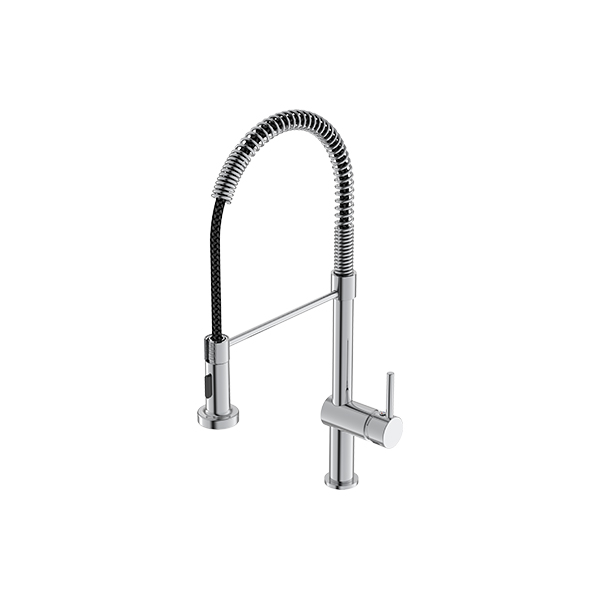
Ceramic disc cartridges
Ceramic disc cartridges use two precision-ground discs made from aluminum oxide (alumina), a material with a hardness of 8 to 9 on the Mohs scale (diamond is 10). The discs are lapped to a flatness tolerance of 0.001 millimeters, creating a watertight seal when pressed together. The upper disc rotates against the stationary lower disc; holes in the discs align to allow flow and misalign to stop flow. Temperature mixing is achieved by varying the alignment of hot and cold water ports.
Durability: Ceramic cartridges are rated for 500,000 to 1,000,000 cycles (approximately 15 to 30 years of typical household use). The hard ceramic surfaces resist wear from mineral particles in water, maintaining sealing integrity over time.
Operation: Provide smooth, consistent lever movement with no “tightening” required to stop drips. Flow and temperature adjustment are proportional to lever position.
Maintenance: When failure occurs—typically due to debris lodging between discs or cracked discs from water hammer—the entire cartridge is replaced. Cartridges are standardized (common sizes: 25 mm, 35 mm, 40 mm diameter) and widely available.
Water quality sensitivity: Ceramic discs are tolerant of normal water hardness but can be damaged by sand, grit, or welding debris in new plumbing. A pre-installation flush of supply lines is recommended.
Compression cartridges (rubber washer)
Compression cartridges use a rubber or silicone washer that is pressed against a metal seat by a threaded stem. Turning the lever rotates the stem, raising or lowering the washer. When the washer is pressed firmly against the seat, the flow stops. Temperature mixing is controlled by separate hot and cold cartridges in traditional two-handle taps, though some single-lever designs use a combined compression mechanism.
Durability: Rubber washers typically require replacement every 2 to 5 years, depending on water quality and frequency of use. Washers compress over time, developing grooves that allow leakage. Hard water accelerates wear.
Operation: Lever operation requires more force than ceramic discs. Users may inadvertently over-tighten the lever to stop drips, accelerating washer wear.
Maintenance: Repairs involve disassembling the tap, removing the old washer, and replacing it. Washers are inexpensive (typically $1–$5) but require basic plumbing skills or professional service.
Water quality sensitivity: Rubber washers are more susceptible to deterioration from chlorine, chloramines, and high temperatures. Hard water mineral deposits can prevent the washer from seating properly, causing drips.
Why the distinction matters for consumers
Long-term cost: While taps with ceramic cartridges typically cost 20 to 40 percent more upfront than compression-based taps, the extended service life and reduced maintenance frequency often result in lower total cost of ownership.
User experience: Ceramic disc taps maintain a consistent lever feel throughout their service life, while compression taps may require increasing force to stop drips as the washer wears.
Repairability: Compression taps can often be repaired with basic tools and readily available washers. Ceramic cartridge replacement requires identifying the correct cartridge type; some proprietary designs may have limited availability.
Water conditions: In areas with very hard water or sediment, ceramic cartridges may eventually be damaged by particulate matter, requiring cartridge replacement. In such conditions, installing a whole-house sediment filter is advisable regardless of cartridge type.
What should I consider when choosing between different spout heights, reach lengths, and swivel capabilities?
The spout configuration of a single lever kitchen mixer tap directly affects functionality, installation compatibility, and user convenience. Understanding these dimensions helps ensure the tap meets the specific needs of the kitchen layout and intended use.
Spout height
Low-rise spouts (150–200 mm from base): Traditional height that fits under wall-mounted cabinets. Suitable for single-bowl basins where clearance for tall pots is not required. Limited clearance for filling large stockpots or cleaning tall items.
High-rise spouts (250–350 mm): Provide clearance for tall pots, pitchers, and deep containers. Allows filling large cookware directly in the sink. Requires adequate clearance between the spout and any overhead cabinets or shelves.
Measurements to consider: Spout height from base to outlet; clearance from base to underside of cabinet (typically 450–500 mm for standard cabinets); clearance from spout to cabinet when tap is installed (some high-rise taps may interfere with cabinet front panels).
Spout reach
Standard reach (200–230 mm from center of base to spout outlet): Suitable for single-bowl basins where the spout outlet aligns with the drain. Provides adequate clearance for washing hands and light kitchen tasks.
Extended reach (230–280 mm): Designed for double-bowl basins where the spout must reach both bowls. Allows water flow to be directed to either bowl without splashing. Common in kitchens with large or multi-compartment sinks.
Measurement considerations: The distance from the tap mounting hole to the far edge of the sink determines required reach. Insufficient reach results in water flowing onto the counter or splashing out of the sink. Excessive reach may cause the spout to extend past the sink edge.
Swivel capabilities
Fixed spout: Does not rotate. Simplest design with fewer moving parts. Suitable for single-bowl basins where water is always directed to the same location.
90-degree swivel: Rotates from the centered position to each side. Common in taps with standard reach for double-bowl basins, where the spout must reach both bowls but not rotate to adjacent counter areas.
180-degree to 360-degree swivel: Provides full rotation range. Allows the spout to be rotated out of the sink area for cleaning or to direct water to adjacent workspaces. Useful in kitchens with large preparation areas adjacent to the sink.
Swivel mechanism durability: Taps with ball-bearing swivels or metal-on-metal rotation points typically last longer than those with plastic bushings. Manufacturers often specify the number of swivel cycles the mechanism is rated for (typically 50,000 to 100,000 cycles).
Pull-out and pull-down spouts
Pull-out spouts: The spray head pulls forward toward the user. Hose length typically 400–600 mm. Suitable for kitchens where the user needs to direct water to the sink or to fill pots on the counter beside the sink.
Pull-down spouts: The spray head pulls down into the sink. Hose length is typically 500–800 mm. Provides greater reach and is better suited for filling large pots placed in the sink. The spray head often includes a magnetic or weight-retraction system to return to the docked position.
Hose durability: Retractable hoses are typically nylon-reinforced PVC or stainless steel braid. Weight systems (counterbalance weights) should be adjustable to accommodate different under-sink cabinet configurations.
Installation compatibility
Mounting hole diameter: Standard mounting hole is 35 mm (1⅜ inches) for single-hole installation. Taps with base plates for three-hole sinks require verification that the plate covers existing holes.
Deck thickness: Deck thickness for standard tap mounting hardware is typically 40–60 mm. Thicker countertops (stone, concrete) may require extended mounting hardware.
Under-sink clearance: The space beneath the sink must accommodate the mounting nut, supply lines, and, for pull-out taps, the hose weight mechanism. Insufficient clearance can prevent proper installation or restrict hose movement.